LAPS WCS

A new manufacturer is a new connector. The core stays as it is.

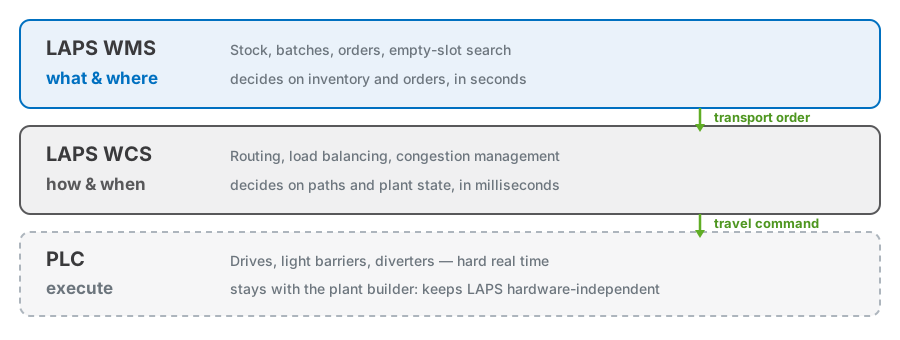
The LAPS WCS (Warehouse Control System — material flow controller) runs the automated areas of your warehouse. The division of labor is clear: the WMS decides what goes where. The WCS decides how and when it gets there. The PLC executes.

Three layers: WMS decides what and where, WCS how and when, PLC executes.
A clear division of labor — and every layer stays replaceable.

Clear division of labor

Two criteria draw the line — knowledge horizon and timing:

  • WMS — stock, batches, orders; decides in seconds to minutes
  • WCS — transport units, routes, plant state; decides in milliseconds to seconds
  • PLC — sensors and actuators in hard real time, with the plant builder; this keeps the WCS hardware-independent
  • The shared key: the transport unit is the storage unit (SSCC)

One contract per equipment type

The core speaks category contracts; vendor-specific connectors below translate to telegrams, OPC UA or proprietary APIs:

  • Conveyors — roller, belt and accumulation conveyors, diverters, turntables, lifts
  • Storage cranes for pallets and totes, shuttle systems with level and channel logic
  • Grid/tote systems such as AutoStore® — subsystems with their own slot management
  • Sorters, robots and machines (palletizers, picking machines), AMR fleets
  • Identification and inspection technology — scanners, scales, contour checks, dimensioning

A new vendor is a new connector — the core stays unchanged.

What travels through the contract

Lean, but complete for the transport job:

  • To the WCS — transport orders with destination or destination zone, priority, cancellation and rerouting, sequence and empties requests
  • Physical properties of the transport unit — load carrier, dimensions, weight, temperature or hazard class
  • To the WMS — order status, destination-slot feedback, checkpoints, inspection results, plant status, stock reconciliation
  • Capabilities instead of assumptions — a missing capability degrades the integration gracefully instead of breaking it

Slot assignment: precise or zone-based

Defined per automated area — both are supported:

  • Slot-precise — the WMS empty-slot search assigns the final slot, optionally in two stages
  • Zone-based — the WMS commissions the destination zone, the subsystem picks the slot and reports it back
  • Typically zone-based: third-party systems and subsystems with their own slot management
  • Inventory management stays with the WMS in both cases — the difference is only who picks the slot

Material flow under control

  • Destination decisions until the last second — the diverting decision is made when the unit reaches the switch
  • Congestion management — rerouting, inflow throttling, back-pressure limits before critical elements
  • Dual cycles and load balancing across aisles and levels — significantly less travel
  • Sequencing for loading orders and pick stations, empties loops, ergonomics buffers

Faults: keep running instead of standing still

Faults are everyday reality in automated operation — what matters is how little of them your customers notice:

  • Automatic reaction by impact — rerouting, aisle shutdown with takeover by the remaining aisles
  • Restart without clearing the plant — a restart reconciliation replaces manual emptying
  • Escalation as a task to maintenance, with the faulty element as reference
  • Plant cockpit — throughput per element, technical availability, top fault sources

Emulation built in

  • Commissioning before the plant exists — the emulator simulates travel times, congestion and faults true to time
  • Acceptance against the connector instead of against the construction site
  • Control-desk training with reproducible fault scenarios, without touching live operation
  • Regression tests for every change to the material flow

See for yourself.