Intelligent
AI that suggests
Forecasts, early warnings and solution proposals — approved by the control room. The AI turns the dials, never the process.
Photograph the delivery note instead of typing it
Not every supplier sends an advance shipping notice — the delivery note often arrives on paper. Typing it in costs time at the dock, and every typo turns into a stock discrepancy later. In the LAPS WMS the operator photographs the delivery note with the handheld or a smartphone, and the AI turns it into an electronic document — matched against the purchase order before anything is posted.
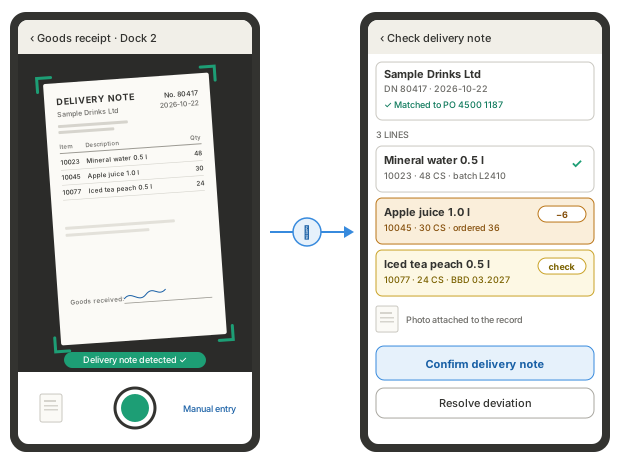
- PhotographHold the delivery note into the frame in the goods-receipt dialog — a handheld or smartphone is enough.
- ReadThe AI reads supplier, delivery note number and order reference, and per line the item, quantity, batch and best-before date.
- MatchLAPS assigns the lines to the purchase order and flags deviations and uncertain fields.
- ConfirmThe operator checks and confirms on the device — only then is anything posted. Anything illegible is entered by hand as usual.
What you gain
No more typing
Goods without an advance notice are received almost as fast as notified goods.
Deviations at the dock
Over- and short deliveries against the purchase order, unknown items, questionable batches and best-before dates below the minimum remaining shelf life show up at receipt.
The document is always there
The photo stays attached to the goods receipt and every line — for supplier queries and exceptions.
No new hardware
The handheld camera is enough. You choose the model: open weight in your own operation or a premium provider.
AI with guardrails
The AI runs next to the WMS core, not inside it. It reads movement and event data and acts only through the dials your control room reviews and approves.
- The same data and the same rule version always produce the same decision.
- No automation without a preview.
- Responsibility stays with people.
A day with AI in the warehouse
- 05:30Shift planning
Staffing needs per zone and shift: the forecast shows bottlenecks before they hit throughput.
- 06:45Goods receipt
The delivery note arrives on paper: one photo with the handheld is enough. The AI reads items, quantities and batches, matches them against the purchase order and flags differences — confirmed on the device.
- 07:15Receiving
Outliers in dimensions and weight stand out before the pallet ends up in the wrong slot.
- 09:40Control room
The problem-pool co-pilot proposes solutions with reasons — and new rules for recurring cases.
- 11:00Exception
A stock discrepancy: the AI narrows it down and attaches the proposed resolution, with the data, to the task.
- 12:30Goods issue
Early warning: route 14 will miss its cut-off. Dispatch rebalances while there is still time.
- 15:00Replenishment
Next week's promotion is detected: thresholds and quantities are ready for approval.
- 22:00Night shift
Slotting proposals for shorter travel, and a stock count exactly where discrepancies are likely.
And when you want to know something, just ask: “Which routes are at risk tomorrow?” — the answer comes from your operational data.